The timer is not the point — what you write when it rings is
23 July 2026 By goaldrift 5 min read
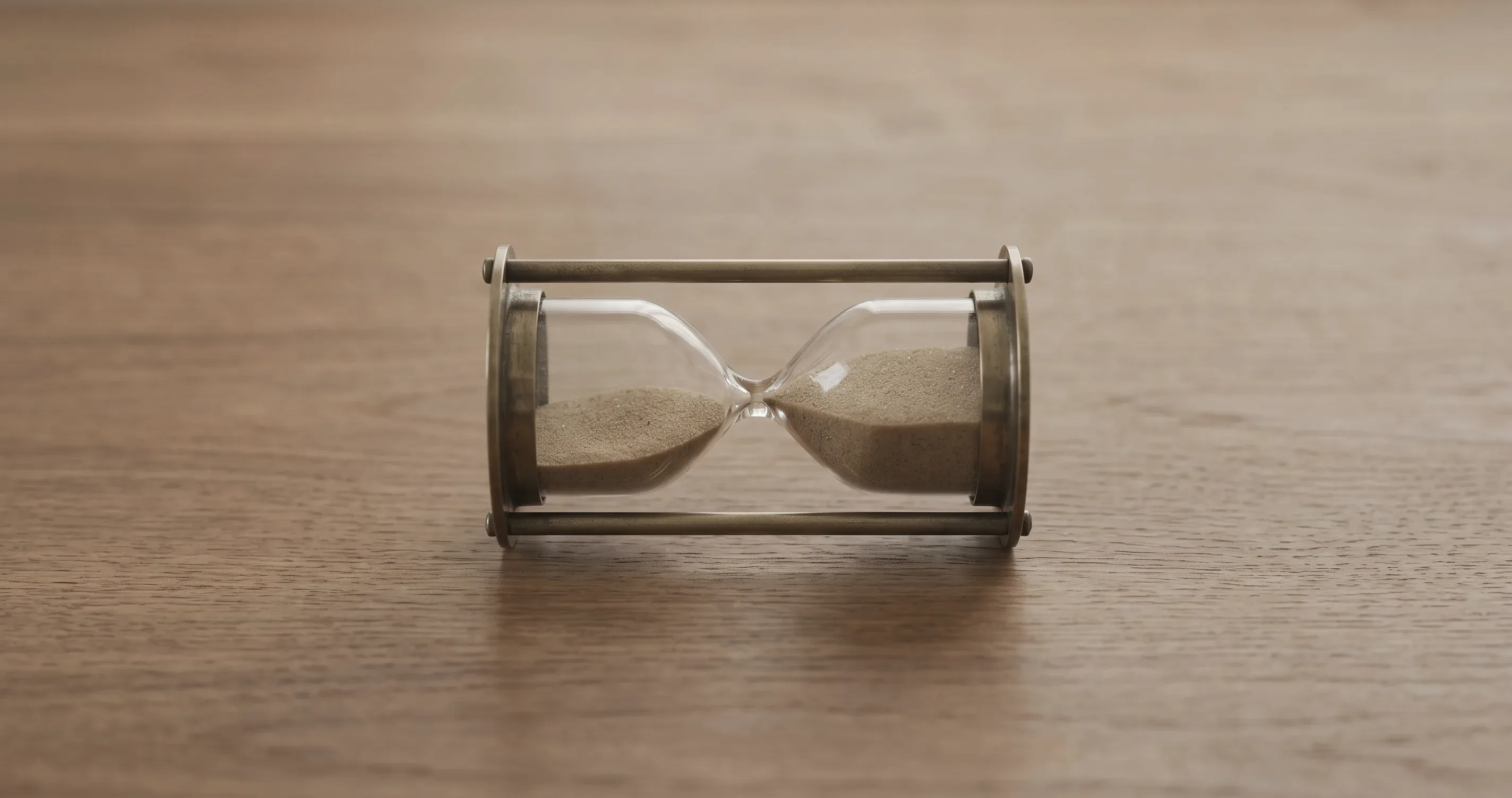
Timers have become the standard answer to not working. Set one, work until it goes, take a break, repeat. It's on every productivity list and most people have tried it.
It does something real, and it's not what people think.
What a timer actually does
One thing: it converts an open-ended commitment into a bounded one.
Work on the report is a commitment of unknown size, and unknown sizes are hard to agree to on a tired evening. Twenty-five minutes on the report is a thing you can evaluate and accept. That's the whole mechanism, and for people who struggle to begin it's genuinely useful.
What it doesn't do is protect your concentration. A timer cannot stop your phone, your colleagues, or your own attention wandering. Starting and continuing are different problems, and a timer only addresses the first.
And it cannot tell you whether anything happened. This is the important gap.
The number is nearly meaningless
Most timer apps accumulate a total — hours this week, sessions this month, a running count.
That number cannot distinguish between an hour where you solved the thing and an hour where you reread the same paragraph. Both are sixty minutes. Both add to the total, and the total is what gets displayed.
So it measures attendance, which is the easiest thing to record and the least informative thing to know. Someone can accumulate forty hours on a project and have nothing, and the total will look excellent throughout. That's the same failure as a tick in a habit grid, at a larger scale.
There's a second problem with totals. Once the number is visible, it starts to matter, and the cheapest way to raise it is to sit at the desk rather than to do the difficult thing. Sessions become something you complete rather than something you use.
You can watch this happen in the small decisions. Staying at the desk when the useful thing would be to go for a walk and think. Choosing the task that fills the time over the one that would finish in ten minutes. None of it is deliberate, and all of it follows from having a number that rewards duration.
What the end of a session contains
The most valuable fifteen seconds of any working block are the ones after it finishes.
At that moment you know things nobody will know later. Where you stopped. What you'd decided. Which approach you ruled out and why. What you were about to try next.
All of that lives in short-term memory and none of it survives a week. Write one line and it becomes permanent. Don't, and it's gone by Thursday — and Thursday's session begins with reconstruction instead of work.
That's why the timer here asks for a line when it rings. Not to log the time, which the app doesn't much care about, but to catch the record at the only moment it can be caught.
What the line does that the timer can't
Three things.
It says what happened, so the session becomes distinguishable from every other session. Two hours, got the auth flow working is a different thing from two hours — and in October, only one of them tells you anything.
It shortens the next ramp. A note about where you stopped means the following session starts at minute five rather than minute twenty. Across a hundred sessions that's a substantial amount of work recovered from nowhere.
It closes the loop. Writing down what's unfinished is what stops the task following you into the next thing. That's the practical use of the closing note beyond the record — it functions as a stopping signal, and unfinished tasks left unrecorded keep some of your attention allocated to them.
The case for tracking time anyway
The honest objection.
For billable work, time tracking isn't optional and the total is the product. Nothing here applies.
There's also a genuine diagnostic use. Someone convinced they're spending their evenings on a project, whose totals show four hours a month, has learned something they'd have disputed. Time data is bad at measuring value and good at catching a mistaken impression of volume.
And some people find the accumulating number motivating in a way that's harmless. If watching the hours build keeps you turning up and doesn't distort what you do in them, that's a fair trade and nobody needs to talk you out of it.
The narrow claim: the total is not a measure of progress, and treating it as one produces the specific failure of a well-attended project going nowhere.
Ninety minutes, twice
Tuesday evening, two arrangements of the same block.
The first: he sets a timer, works, and it rings. He stops, closes the laptop, and the app adds ninety minutes to the week's total, which now reads seven hours. He feels reasonably good about seven hours.
Thursday he opens the file and spends twenty minutes working out where he was, because the last thing he remembers is that something wasn't working.
The second: same ninety minutes, and when it rings he writes stopped halfway through the costs section, don't have the Q2 figures — chase Ravi.
Thursday starts at minute five. The Q2 figures get chased on Wednesday, because the note was visible. And in October, reading twenty entries in a row, the pattern is legible in a way seven hours a week could never be.
Same effort, same timer, and one of the two produced something that lasts.
Three things to keep. Bound the session, at a length that suits the work — short for anything that resumes instantly, longer for anything you have to load.
Write a line when it ends. What you did, where you stopped, what's next.
And don't treat the accumulated total as a score. It's a record of attendance, and attendance was never the thing you were trying to measure.
Related: Ninety minutes is the unit · One line is enough · Pomodoro after twenty years
Share: