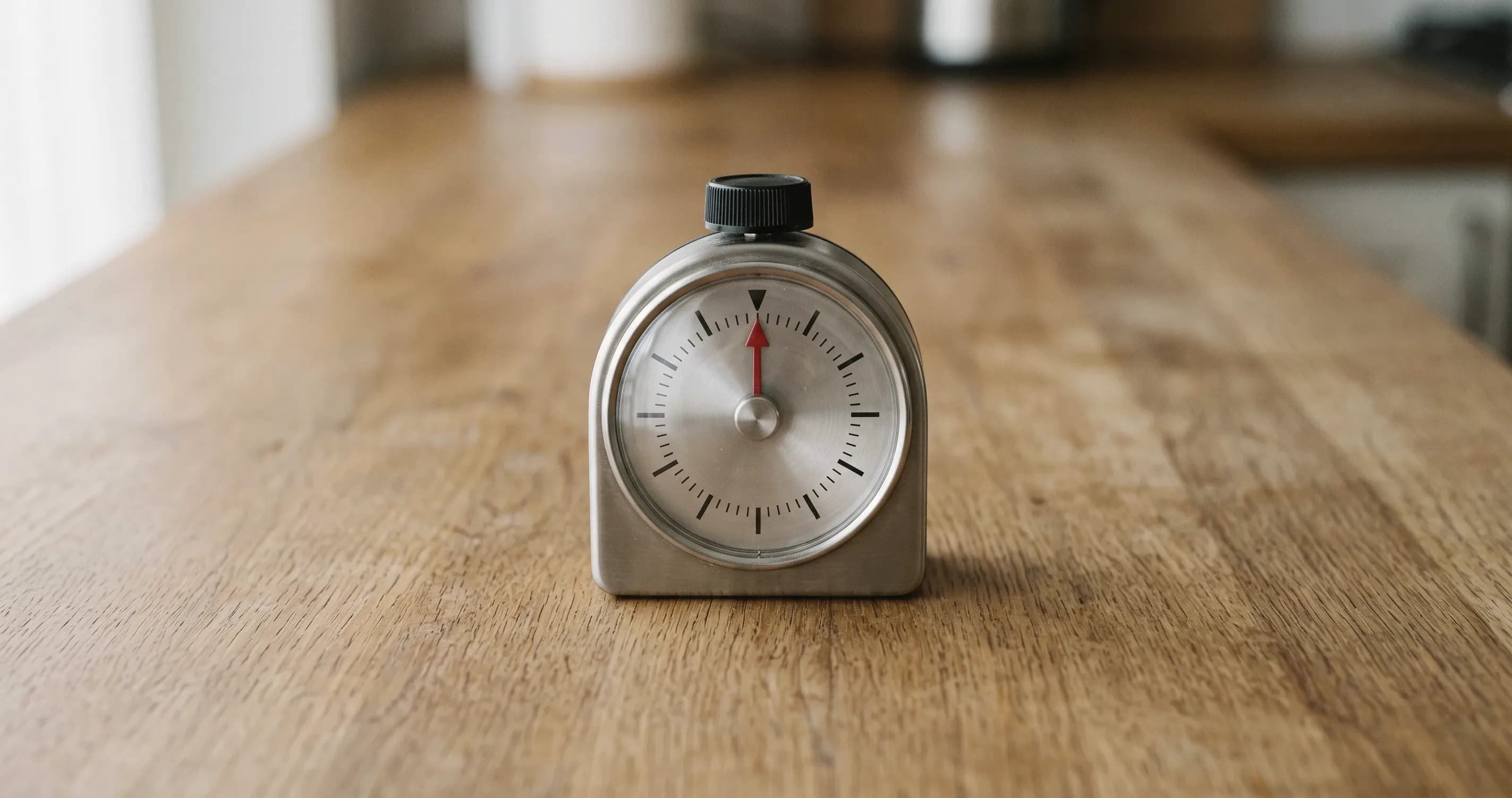
There's a length of working session that people aim for and a length that actually happens, and they're rarely the same.
The one people aim for is the clear afternoon. Four hours, no interruptions, the phone somewhere else. It's the session in which the difficult thing finally gets done, and it appears in the diary roughly twice a month, both times cancelled.
The one that happens is ninety minutes, and it's better than it sounds.
Why not thirty
Thirty minutes is enough to move something. It isn't enough to think.
Any work with depth in it has a warm-up — getting the material back in your head, remembering where you were, rebuilding the shape of the problem. For anything cognitively substantial that's usually ten to twenty minutes, and it isn't optional. It happens whether you plan for it or not.
Which means a thirty-minute session spends most of itself arriving. You get twelve useful minutes at the end, just as the material comes back, and then you stop. Do that repeatedly and you can put in five hours a week while never once getting past the surface of the problem.
Short sessions are excellent for keeping contact with a goal — that's a real and separate use, and it's what an unstick move is for. They're poor at producing the work.
The two uses get confused constantly, and it causes a specific disappointment. Someone commits to twenty minutes a day on a book, keeps it faithfully for a month, and has almost nothing to show. The discipline was real and the diagnosis is wrong: they haven't failed at writing, they've been doing the keeping-contact activity and expecting the producing-work result. Both are worth doing. They aren't substitutes.
Why not four
The long session fails for two reasons, one about attention and one about arithmetic.
Attention doesn't hold for four hours. Somewhere past the ninety-minute mark it stops being sustained concentration and becomes a slower, less accurate version of itself — still productive, but at a rate that keeps dropping, and with mistakes you'll find later. Most people can feel this happen and push through it anyway, which is how afternoons produce work that needs redoing.
The arithmetic is the bigger problem. A four-hour block requires four uninterrupted hours to exist, and for most people with jobs, children or shared houses they exist rarely. Building a practice on a resource that scarce means building a practice that runs twice a month. Ninety minutes fits in an evening after the house is quiet, a lunch break plus a bit, an early start before anyone else is up. It survives normal weeks, and surviving normal weeks is what determines whether a thing gets finished.
What the ninety is made of
Roughly: fifteen minutes arriving, an hour of the real thing, fifteen minutes landing.
The arriving is not wasted time and shouldn't be fought. Reading what you did last time, opening the files, getting the shape back — this is the cost of entry and pretending otherwise just means doing it badly.
The hour in the middle is the point. It's long enough to hold a whole problem, follow it somewhere unexpected, and come back.
The landing is the bit people skip, and it's the highest-value fifteen minutes in the session. Stop before you're empty. Leave a note about where you got to and what you were going to try next. That note is the thing that makes the next session start at minute five instead of minute twenty, and it costs almost nothing to write while the work is still in your head.
Stopping mid-thought rather than at a natural end is worth doing deliberately. A session that ends with something unfinished and obvious to do is far easier to return to than one that ends at a tidy boundary with nothing pending. Finishing a chapter and closing the laptop feels satisfying and makes Thursday harder, because Thursday now begins with deciding what the next chapter is.
Two ninety-minute sessions a week is also a more useful frequency than one three-hour one, for a reason that has nothing to do with attention. Three days apart, the work is still warm. Nine days apart, it isn't. Frequency is doing more of the work here than duration, which is the opposite of how people plan.
Where the number is wrong
The honest caveats, because this is a heuristic dressed as a fact.
Ninety minutes is a poor fit for work with a long warm-up. Some technical and analytical work needs forty minutes just to load, and ninety leaves you fifty useful ones, which may not be enough to be worth the entry cost. If that's your work, you genuinely do need the long block and should be defending it in your calendar rather than shrinking it.
It's also wrong for work with no warm-up at all. Practising scales, routine admin, physical training — these start at full speed, so the whole argument collapses and you should use whatever time you have.
And people vary more than any round number admits. Some hold three hours comfortably; some are finished at fifty minutes and produce nothing useful afterwards. The number's real job is to be long enough to think and short enough to happen, and finding your own version of that is worth more than adopting anyone else's.
The one thing that generalises: whatever your number is, it's almost certainly shorter than the session you've been waiting for and longer than the ones you've been settling for.
Six weeks of Tuesdays
Someone is writing a technical book alongside a full-time job. The plan is Saturday mornings, four hours, which is the right amount of time and the wrong shape.
Over six weeks, five of the six Saturdays are lost — a wedding, a broken boiler, a weekend away, and two that simply evaporated. The sixth happens, and it's genuinely good: four hours, most of a chapter. Six weeks, one chapter, and a growing sense that the book isn't going to happen.
He changes it to Tuesday and Thursday evenings, nine to half ten, ninety minutes each. The gain isn't the hours, which are roughly the same across a fortnight. It's that the sessions actually occur, because nine in the evening is a time he reliably has and Saturday morning is a time he theoretically has.
The second effect is larger and took him longer to notice. Under the Saturday plan, each session started cold from three weeks earlier, and the first hour went on remembering. Under the Tuesday-Thursday plan, two days is short enough that the material is still warm, so each session starts at minute five. The effective working time roughly doubles for the same hours in the diary.
Six weeks later he's four chapters in, on a schedule that looked, on paper, like less time than the original.
What gets written down
The session isn't the thing goaldrift records. The line at the end is.
Ninety minutes with nothing written down leaves no trace — you'll know you worked, vaguely, and in four months you won't be able to say on what. Ninety minutes plus one line leaves a record you can read backwards, and clears the counter besides.
That's why the timer asks for a line when it rings, at the one moment when what happened is still in your head. Ten seconds of writing at the end of ninety minutes is the cheapest thing in the whole practice, and it's the part that makes all the other sessions legible later.
Related: The thirty-minute unstick · One line is enough · Logging beats tracking
Share: