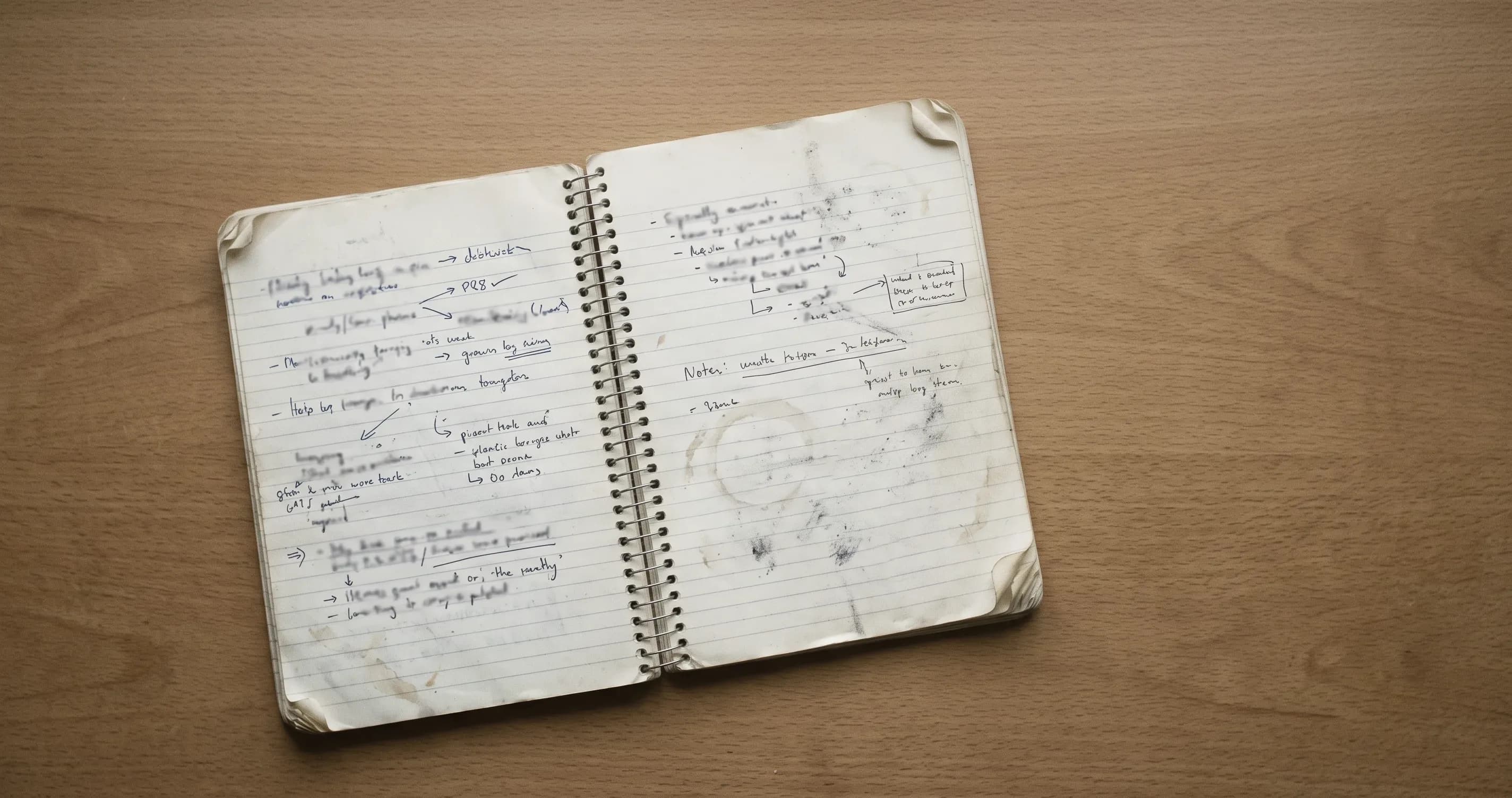
There's a version of the work journal that gets written about, and a version that survives, and they aren't the same thing.
The written-about version has a dedicated notebook, a time of day, prompts, and an expectation of reflection. It runs for about six weeks. The surviving version is three lines typed into whatever's already open, with no notebook and no time of day, and it runs for years.
The difference is ceremony, and ceremony is the thing to strip out.
Why the good version fails
Three obstacles, and each one is enough on its own.
It needs a mood. Reflective writing requires a certain frame of mind, and that frame is least available on the days most worth recording — the flat ones, the ones where nothing worked. So the journal fills with good days and goes silent through bad ones, which is precisely backwards, because the bad ones are the data.
It needs a slot. Fifteen minutes at the end of a long day competes with sleep and loses, reliably, and the loss doesn't feel like a decision.
And it needs something to say. A blank page implies a standard, and an ordinary Tuesday doesn't meet it. So Tuesday produces nothing, and a fortnight of Tuesdays produces a gap, and a gap in a journal is oddly hard to write past — it starts to require an explanation before you can resume.
That last obstacle is the one that finishes most attempts. The practice doesn't end because someone decides to stop; it ends because resuming after three weeks means acknowledging three weeks, and acknowledging three weeks is more effort than the entry is worth. So the notebook stays shut, and the only thing it produces from then on is guilt.
What survives instead
Four properties, all of them subtractions.
No dedicated place. The journal lives where you already work: the goal itself, a file that's already open, whatever you have. Every additional object between you and writing is somewhere the habit can fail, and a special notebook is a whole extra object.
No time of day. It happens when the work stops, whenever that is. Practices tied to an hour die the first week your hours change, and everyone's hours change.
No minimum. One line is a complete entry. Two hours, got the auth flow working. Didn't. Too tired. Under ten seconds, no standard to meet, no mood required.
No reflection. This is the surprising one. Descriptions are far easier to write than assessments, and much more useful later. Drafted the costs section, don't have the Q2 figures is worth more in October than any amount of thinking about how the session felt — and it takes a quarter of the effort, which is why it still gets written in month eight.
What it's actually for
Not self-knowledge, which is the framing that makes it feel like homework. Three concrete uses.
Restarting. The single most valuable line is the one saying where you stopped. It removes the reconstruction cost from a return, which is the thing that makes returning feel enormous. This alone justifies the practice.
Not redoing work. Six months on you'll have forgotten which approaches you ruled out. Tried the queue version, doesn't handle retries saves an evening a year later, and this happens more often than people notice, because the second attempt feels like a fresh idea.
Correcting the story. When your sense of a project and the record disagree, the record is usually right. Memory reports the mood; the log reports the work, and on bad weeks the difference is large enough to change decisions.
None of those three requires you to be insightful, or even particularly honest with yourself. They only require that something got written down at the time, which is a much lower bar than the usual framing sets and the reason this version lasts.
Where the elaborate version wins
The counter-argument, because there's a real thing being given up here.
Writing at length forces thinking you wouldn't otherwise do. Working out on paper why an approach failed is a different cognitive act from noting that it did, and it sometimes produces the insight that unblocks the whole thing. People who keep proper journals aren't being precious — they're getting something the minimal version doesn't offer.
Reflection also has value the record can't supply. Noticing that you've been anxious for three weeks, or that a job has stopped being interesting, is the sort of thing that surfaces during unstructured writing and not during a one-line description of what you did.
The claim here is only about what to default to. When the choice is one line or nothing — which is the actual choice most evenings — one line wins by a mile. Write the long version when you have something to work out. Don't build the practice on the assumption that you'll want to.
Nine months, about forty minutes
He starts a proper work journal in January. Good notebook, ten minutes at the end of the day, three prompts he found online: what went well, what didn't, what I'd change.
It runs for five weeks. The gaps start in the second week of February — a late night, then a week away, then a Monday where opening it means writing about a bad Friday. By March it's stopped, and the notebook goes in a drawer where it produces a small wince for the rest of the year.
In September he tries again, differently. No notebook. A line typed into the goal itself when he finishes working, whatever time that is.
Two hours on the migration script, works for the simple case. Nothing, client meeting overran. Rewrote the error handling, still not right. Nothing. Nothing — stuck on how to handle partial failures, need to think. Talked it through with Sam, going to split the retry logic out.
Nine months later there are about two hundred entries, and the total time spent writing them is maybe forty minutes. It's never once required a mood, and there's no gap he's had to write past, because there's nothing to resume — each line is independent.
The notebook version had eighteen entries, all of them better written, and none of them any use.
Where the line goes
In goaldrift the line goes on the goal, and writing it is what clears the counter. Not ticking, not opening the app — writing something.
That's the only ceremony there is, and it's the useful bit: the counter means days since you last had a thought about this worth recording, rather than days since you last tapped anything.
Two things reduce the friction further. Ticking a step off writes the note for you, since you've already said what you did. And the focus timer asks for a line when it rings, at the one moment when what happened is still in your head and costs nothing to record.
Ten seconds later it's gone, and an evening that produced something real becomes indistinguishable from one that didn't.
That's the whole system. No notebook, no prompts, no time of day, and nothing to catch up on when a fortnight goes by without an entry — because there's nothing being maintained, only a record being added to whenever there's something to add.
Related: One line is enough · Logging beats tracking · Notes as evidence
Share: