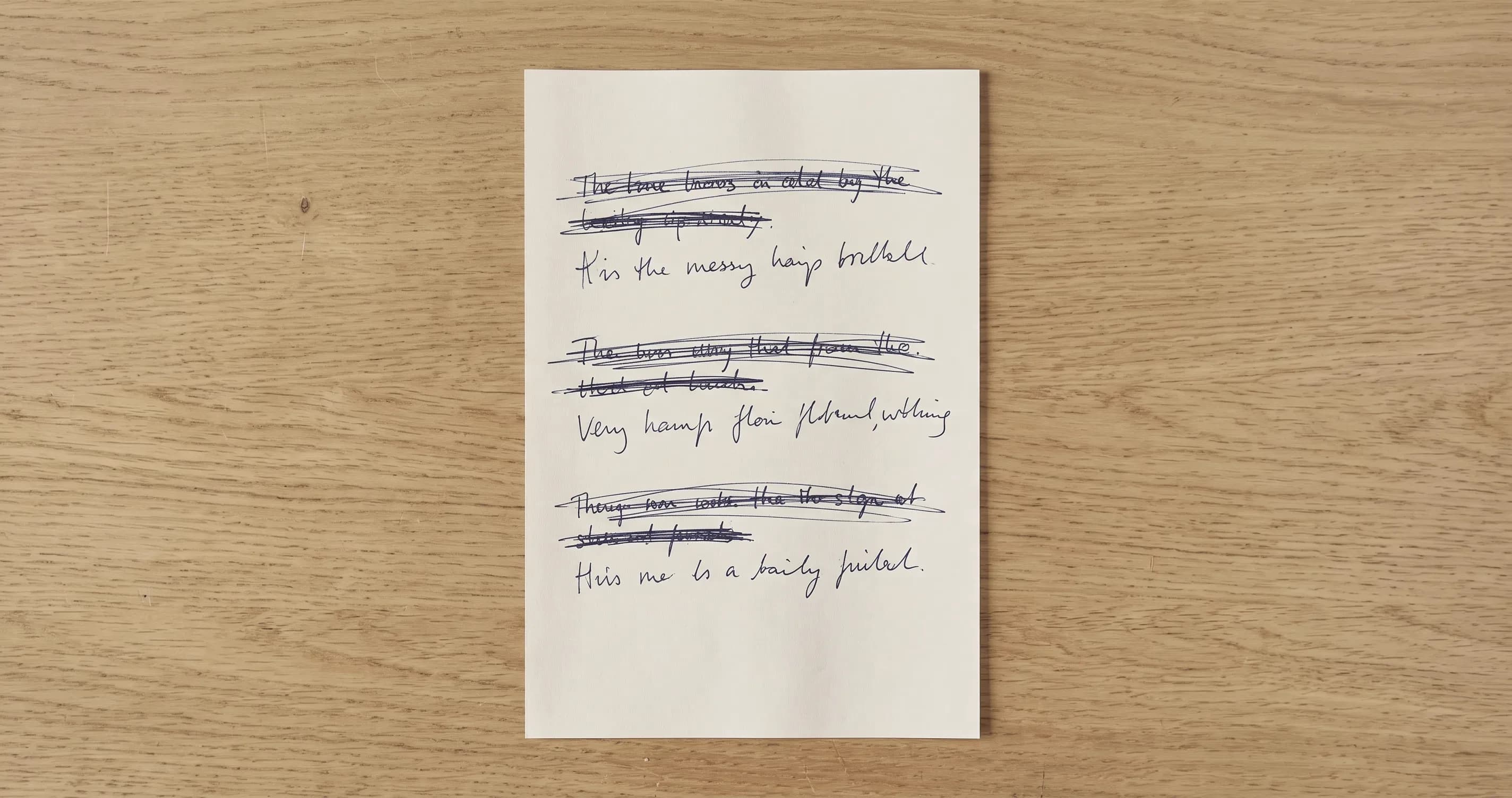
The goal has been on the list since February. In that time you've rewritten it four times.
In March you made it more specific. In May you split it into three sub-goals, which felt like a breakthrough. In July you decided the whole framing was wrong and started again with a better one. Last week you added a deadline.
What you haven't done, at any point in seven months, is the thing.
Why this is so effective at hiding
Because it's indistinguishable from taking something seriously.
A person rewriting a goal for the fourth time is thinking hard about it, engaging with it, applying judgement. They come away from the evening having produced something better than what they had. Every observable feature matches diligence.
And it delivers the reward. The pleasant feeling that doing the work would have produced — the sense of having moved — arrives on schedule, from an activity that carries no risk of finding out whether you can do the thing. That's an extremely efficient trade, and once your system has found it, it will keep going back.
It also has an excellent alibi. Sometimes goals genuinely are badly specified and rewriting them is exactly right. So there's always a defensible reading available, and the defensible reading is the one you'll adopt.
One question: has this goal been reformulated more recently than it's been worked on?
If yes, the reformulating is the avoidance. That's close to a rule rather than a heuristic, and it holds up even when each individual rewrite was an improvement.
Two supporting tells. The rewrites get more elaborate rather than simpler — a goal that started as one sentence now has phases, success criteria and a review schedule. And nothing structural has changed between versions: the same next action was available in February as is available now, and it hasn't been taken.
Why goals attract this specifically
Three reasons, and they're worth separating.
Planning is genuinely productive-feeling and genuinely low-risk. You can't be wrong about a plan yet. The work of executing it can be bad; the plan itself can only be improved.
Goals are also unusually easy to make plausible arguments about. There's a whole literature saying they should be more specific, more measurable, split into smaller pieces, tied to a why. Every one of those provides a legitimate-sounding reason to spend an evening on the text rather than the task.
And the goal is the only part of the project that's fully under your control. The work involves difficulty, other people, and the possibility of failure. The sentence describing it involves none of those, so under pressure attention drifts to the part that behaves.
There's a fourth reason that's specific to ambitious people, and it's the least comfortable. A perfectly formulated goal is a way of demonstrating seriousness without incurring any risk. The more elaborate the plan, the more it signals commitment — to yourself, mostly — and signalling commitment is a great deal easier than being committed.
Where rewriting is right
The counter-argument, because a rule this blunt will misfire.
Sometimes the goal genuinely is wrong, and rewriting it is the highest-value thing you can do. A goal that's a vague noun needs converting into an action; one that's inherited needs deleting; one whose circumstances have changed needs updating. Refusing to revise on principle produces people doggedly working towards something that stopped making sense in March.
The distinguishing feature is what the rewrite changes about tomorrow. A useful revision alters what you'd do in the next thirty minutes — you now have a specific first action you didn't have. An avoidant one alters the framing and leaves tomorrow exactly as it was.
There's also a legitimate version that happens once, early. The first two weeks of a goal often involve real reformulation as you find out what it is. That's discovery, not avoidance. It's the fourth rewrite in month seven that's diagnostic, not the second one in week two.
Four versions of the same thing
February: Write a book about surveying.
March, after reading something about specificity: Write a 60,000-word practical guide to residential surveying for junior surveyors, finished by December.
May, after reading something about breaking goals down: three sub-goals — research, outline, draft — each with its own dates.
July, a rethink: Build an audience first, then write the book. This one takes a whole Sunday and feels like the most clear-headed thinking he's done on it. It also postpones the writing indefinitely, which nobody says out loud.
September, tidying: a deadline added to the audience-building goal.
Across all of that, the amount of the book that exists is nothing. The next action was the same in February as it is in September — write eight hundred words about damp, the thing he knows more about than almost anyone — and it has never once been the thing he did with an evening.
What breaks it isn't a better goal. It's a rule: no changes to the text until there are two thousand words in the file. The goal is now frozen at a version he doesn't think is optimal, which turns out not to matter at all.
The freeze rule
That's the practical fix, and it's crude on purpose.
Pick the current version, however imperfect. Write it down. Then no edits until some specific quantity of actual work exists — a thousand words, three sessions, one thing shown to somebody.
The imperfection is tolerable because a mediocre goal you're working on outperforms an excellent one you're not, by a margin that isn't close. And you'll learn more about the right formulation from three sessions of doing it than from three evenings of rewriting it, because the doing produces information and the rewriting only produces confidence.
If the goal turns out to be genuinely wrong, you'll know within those three sessions, and then the revision is earned.
It helps to write the freeze condition on the goal itself, so it's visible next time you open it with the urge to tidy something. No edits until 2,000 words. That sentence will look faintly ridiculous in October and it will have done its job by then.
What the record shows
This is one of the patterns a log catches and memory doesn't.
Each rewrite feels like a fresh insight at the time — that's the whole trick. Read back as entries, they look different: reworked the goal, much clearer now, then eight weeks later restructured into three phases, then decided to build the audience first. Three entries about the goal and none about the work.
The counter shows the other half. A goal that's been rewritten four times and worked on never will read 40, 60, 90 days quiet, because editing the text isn't contact with the thing. That's the number's most useful property here: it can't be cleared by planning.
Related: Why the goals you care about most go quiet first · What a goal looks like the week before you lose it · Write the goal so tomorrow-you knows what to do
Share: