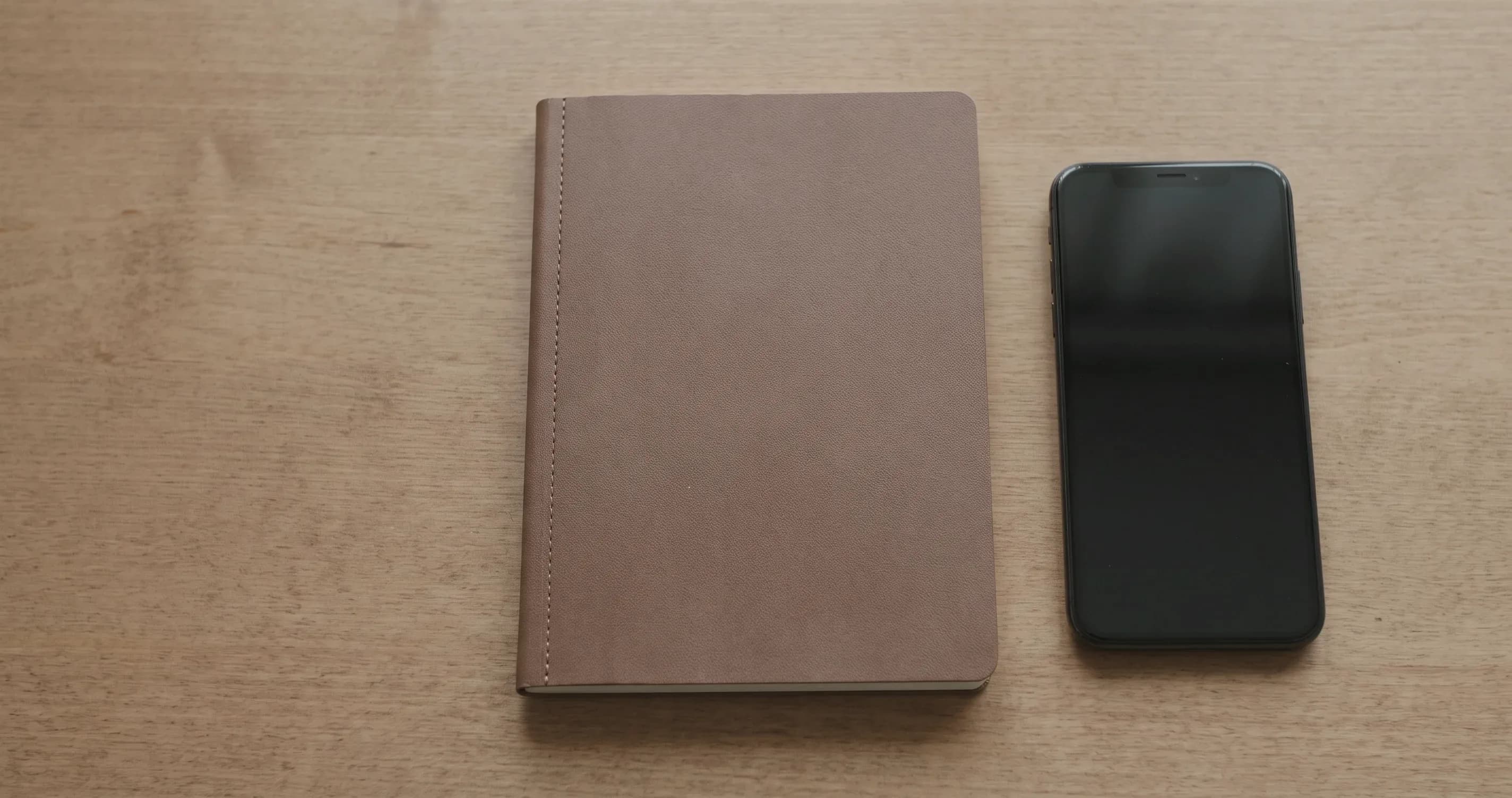
The argument usually gets conducted as a matter of taste — people who like paper defend paper, people who like apps defend apps, and both produce reasons afterwards.
There's a more useful version, because the two differ in ways that are structural rather than aesthetic. Each does something the other genuinely cannot, and once you know which of those you need, the choice takes about a minute.
What paper does that an app can't
It slows you down. Handwriting is roughly a fifth the speed of typing, and for reflective work that's an advantage rather than a cost. You can't skim your way through writing a page. People who switch to digital often notice their reviews got faster and shallower at the same moment, and don't connect the two.
It has no adjacent temptations. A notebook contains only what you wrote. A screen contains everything, one gesture away, and the pull is real even when you resist it.
It's physically present. An open notebook on a desk is a visible object in a room. An app is invisible until opened, and things that are invisible are easy not to open.
Nothing changes it. No updates, no redesigns, no feature you relied on being removed, no terms to re-accept. The notebook you bought in 2019 works identically today.
What an app does that paper can't
It counts time. How long since you last touched this is calculated, automatically, and it's simply not available on paper — a goal quiet since March is a fact spread across four monthly spreads, recoverable only by someone who goes looking. If measuring silence is the point, paper cannot do it.
It orders by something other than your preference. A page is in the order you wrote it, which means the uncomfortable goal sits where you put it, and you'll put it low. Automatic sorting by neglect removes a choice you'd otherwise make badly.
It searches. Three years of notes, one goal, in a second. The paper equivalent is an index you maintain by hand, which is a decent approximation and considerably more work.
It doesn't accumulate arrears. Miss a month of migrations and a notebook is behind, and catching up is a tax you pay before the system is usable again. An app with a calculated state is simply correct when you return, with larger numbers.
What each is better at, in one line
Paper is better at thinking. Apps are better at counting.
That's a genuine division rather than a rhetorical one, and it explains why the argument never resolves. Two people can both be right about their own experience while describing different needs, and neither will convince the other, because the disagreement isn't about the media at all.
Almost everything above reduces to that. The slowness, the absence of distraction, the physicality — those serve reflection. The dates, the sorting, the search — those serve measurement.
Which means the honest question isn't which is superior. It's whether your problem is that you don't think about your goals carefully enough, or that you don't notice when they've gone quiet.
The cases where it's not close
Three situations where one option is clearly right.
Long absences. If you disappear for weeks at a time, an app wins decisively. Paper's monthly migration accumulates arrears exactly when you had no capacity, and the arrears are what stop people going back.
A record you'll want in ten years. An app with an export beats a shelf of notebooks for retrieval, and loses on durability if the company folds and there's no file. That trade tips on whether you can get the data out — which is worth checking before committing to anything.
Deep reflective work. If what you need is to think something through at length, paper is better and it isn't close. Nothing about a screen helps with that, and several things hinder it.
The hybrid that works
Most people who use both arrive at roughly the same division, and it holds up.
Notebook for thinking: the working out, the reflection, the pages nobody else reads, the material that benefits from being slow.
App for the short list of live goals: the gap number, the ordering, the states, and one-line notes that need to be readable in three years. Four or five items, not a whole system.
The failure mode is running both as complete systems, which produces two lists that disagree and a maintenance burden that collapses by March. One home for goals, whichever you pick.
Take a goal you've had on and off for three years. Answer, right now, without looking: when did you last touch it, and what were you doing when you stopped?
If you can't, and you'd like to be able to, that's the measurement problem and paper can't solve it.
If you can, or if the question doesn't interest you, then measurement isn't your gap — and a notebook you actually use is worth more than an app you'll uninstall in April.
The rule that matters more than either
Whatever you choose, use one.
The most common failure isn't picking the wrong medium. It's running a notebook and two apps, none of them complete, with the goals split across all three and the true state in none of them. That arrangement fails regardless of the merits of any component.
A notebook you use beats an app you don't, and an app you use beats a notebook you've stopped opening. The medium matters much less than the question of whether the thing is still current in September.
Which is worth remembering before spending an evening comparing options. The main determinant of whether any of this works is whether you'll still be doing it in six months, and nothing in a feature comparison predicts that.
Related: Bullet journalling vs digital goal tracking · Spreadsheets are underrated for goals · Logging beats tracking
Share: