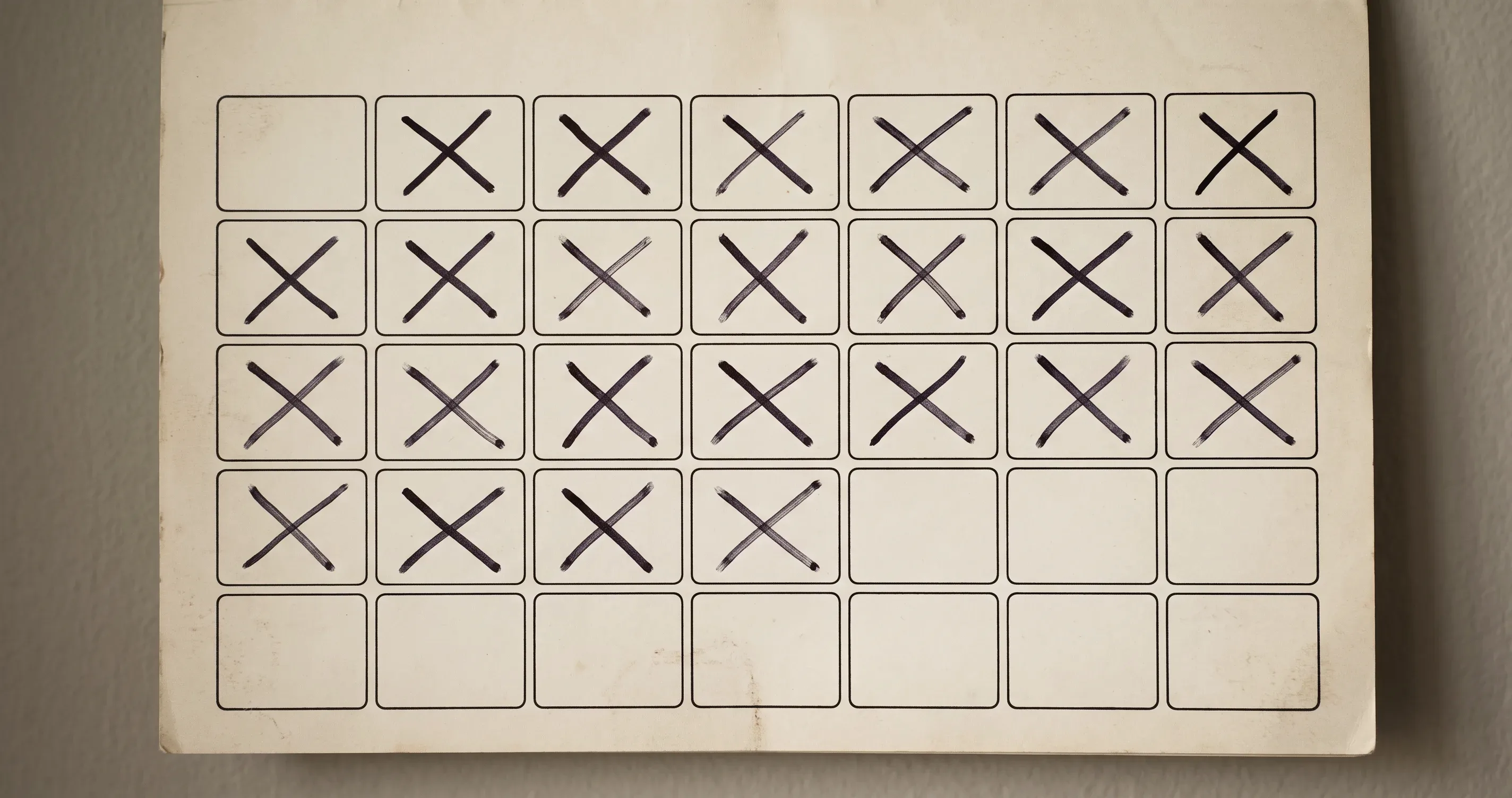
Get a big wall calendar. Every day you do the thing, put a red cross through the day. After a few days you have a chain. Your only job is not to break it.
The method is usually attributed to Jerry Seinfeld, who has said it isn't his, which is a fair summary of how productivity advice travels. Whoever originated it, it has outlasted almost everything else in the genre, and it deserves a proper account rather than a dismissal.
Why it works when it works
Three genuine mechanisms.
It removes the decision. On any given day the question isn't do I feel like writing, it's am I breaking the chain, and the second question is much easier to answer. Decisions lose to tiredness; a rule doesn't.
It makes an invisible thing visible. Effort spread over weeks leaves no trace, and a wall of crosses is physical evidence that something has been happening. For work where progress is imperceptible day to day — a language, a practice, early fitness — that evidence is genuinely valuable.
And it's honest about the unit. The method doesn't care whether the writing was good. It asks whether you turned up, which is the only thing you can reliably control, and for a beginner that's the correct thing to be measuring.
None of that is trivial, and a great many people have built real practices on it.
The four conditions
It works under narrow conditions, and they're worth stating because the advice never does.
Daily. The chain requires an unbroken sequence, so a goal that's meant to happen twice a week has no chain to protect. You can adapt it with rest days, and adapting it removes the thing that made it work — the rule stops being unambiguous and becomes a matter of interpretation.
Small. The daily requirement has to be achievable on your worst day, or the chain will break on the first bad one. That means twenty minutes, not two hours.
Unambiguous. You need to know at the end of the day whether you did it. Write is unambiguous. Work on the business isn't, and a chain built on a fuzzy criterion becomes a chain built on generosity to yourself.
Unbroken. The whole mechanism is the streak. This is the condition it can't survive, and it's the one guaranteed to fail eventually.
Most of what people actually care about fails at least one. Shipping a beta isn't daily. Writing a book isn't small. Getting fit after an injury isn't unambiguous.
The mismatch matters because the advice is offered universally. Somebody reading it about a book, or a business, or a qualification is being given a tool designed for a daily twenty-minute practice, and when it doesn't hold they conclude the problem is them rather than the fit.
What happens on day 35
Everything about the method is excellent until the day it breaks, and then it turns.
You're ill, or travelling, or the day disappears. The chain is gone, and what you're looking at is not 34 days out of 35, which is a strong record. It's zero — the same as before you started.
The number itself isn't the damage. It's the arithmetic that follows, which almost everyone does and nobody says out loud: thirty-four days to build that, and I'd be starting from nothing. The skill hasn't gone anywhere. The chain has, and the chain was what you'd been watching.
So the return acquires a price, and the price is proportional to how long the chain was — which means the method punishes its most successful users hardest. That's an odd property for a system meant to support people, and it's not a flaw in the implementation. It's what a resetting counter does.
The honest defence
Two things in its favour that survive all of the above.
For a beginner establishing something daily and small, nothing else in this genre works as reliably. Someone who wants to write every morning and never has will get further with a wall calendar than with any amount of thinking about systems. The conditions it needs are exactly the conditions of a starting habit.
And plenty of people do come back after a break. The catastrophic version isn't universal — for some, the chain turns out to have been scaffolding they no longer needed, and the practice continues without it. That happens, and it isn't rare.
The criticism isn't that it never works. It's that it works under conditions that expire, and that the failure mode arrives for everyone eventually and is worst for those it worked best for.
What to keep, what to replace
The useful parts are separable from the mechanism.
Keep the daily minimum, and make it small enough for a bad day. Keep the rule that removes the decision. Keep the visible record, because evidence of effort is genuinely valuable when progress is invisible.
Replace the reset. Instead of a chain that collapses, count the gap — days since you last did it. It rises while you're away and one session sets it to zero, whatever the number was. The record is still visible, the daily minimum still applies, and the day you miss produces 1 day rather than a verdict.
That keeps all three mechanisms and removes the condition that ends practices.
It's a small change and it inverts the direction of the number, which sounds cosmetic and isn't. A number that rises while you're away is a measurement. A number that collapses when you miss is a penalty, and the difference shows up entirely on the day something goes wrong.
Two hundred and fourteen days
She keeps a chain for seven months on a language app. Twenty minutes most evenings at first, five minutes by the summer, because five minutes keeps the chain and twenty doesn't feel available on a Tuesday.
That's the second failure, quieter than the first: measured on consecutive days, the cheapest way to protect the chain is to do the minimum that counts. The practice hollows out while the number keeps rising, and the number is what she's watching.
Then a wedding weekend, bad signal, and on Sunday morning it's zero.
She goes back twice that week and not at all the week after. Nothing was decided. The Spanish is still in her head, seven months of it, and the thing she'd been protecting isn't.
A gap counter would have said 1 day that Sunday, and 8 days, stalled the next — at the top of the list, where it's hard to ignore. And whenever she returned, in October or the following March, one session would have cleared it, at no charge for having been away.
Related: The case against streaks · What breaking a 200-day streak does to you · Gamified productivity and the motivation it replaces
Share: